

Author’s Note: This post is the first of a series. Each post will focus on each day of Building Blackboard Together 2026 and include a final evaluation of the conference based on my preview and thoughts in June’s blog post about the conference.
DevCon is back. Let that sentence sit for a second, because for a lot of us who have been in this community a long time, it means something. Dom Gore kicked off the first DevCon since it was retired back in 2019. I’ve spent a good chunk of the years in between pushing, publicly and privately, for Blackboard to bring it back. So has Chris Bray. So have numerous other admins and developers who never stopped believing there was still an audience for a technical track that goes deeper than a product demo. Dom gave us a shout-out during his remarks for that persistence, and I appreciated it. But the real credit goes to Blackboard for actually listening and following through.
Why DevCon matters and why its absence was felt.
A general session tells you what a product does. DevCon tells you how to make it do what your institution actually needs. That distinction matters enormously to admins and developers who live inside the REST APIs, LTIs, and integration layer every single day. The return of DevCon gives that community a dedicated home again, and based on the turnout and the energy in the room, it’s a home people missed.
My session: AI-assisted scripting for Blackboard admins.
I had the opportunity to present on how I’ve been using AI to write and refine the scripts and processes that make my day-to-day work as a Blackboard administrator more efficient. This isn’t theoretical for me. It’s the actual workflow I use to handle repetitive administrative tasks that used to eat hours of my week. If you want to see the full presentation, it’s posted online at presentations.blackboard.guru/devcon-ai-coding.
AI-DLC, from the people building it.
Rich Desiano, VP of Architecture at Blackboard, and Rodrigo Asensio, Senior Manager of Architecture at AWS, walked through AI-DLC. Don’t know what AI-DLC is? Well, you are just like me before this session. AI-DLC (AI-Driven Development Lifecycle) is a software development methodology where AI acts as a core teammate and executor, while humans provide context, strategic direction, and oversight. This methodology was developed by AWS and is open source for anyone to use. The presentation reviewed how engineers and developers within the company were using this methodology to make improvements in the quality and speed of features and enhancements within the application. Using AI to do what AI does best, while leaving human users to maintain control and direction. For those of us who have worked with Blackboard for now over two decades, this insight gives us a peek behind the curtain that really educates us on “how the sausage is made”. This is precisely the kind of session DevCon was built for: two people directly responsible for the architecture talking candidly with the admins and developers who have to live with the results.
Why does this matter to you? First, it’s important to understand that features and improvements will be coming at a faster pace with methodologies like this implemented. It also means more changes are coming in each release. That insight helps admins and developers plan on how they will manage the increase in change, whether it’s in code, workflows, or for end users.
The Blackboard MCP server demo.
Scott Hurrey demoed the Blackboard MCP server, and I’ll admit I had a personal stake in watching this one closely. MCP stands for Model Context Protocol, an open standard created by Anthropic in November 2024. It acts like a universal connection for large language models (AI), a standard way to connect to external tools, local files, and live data sources, normally through currently supported frameworks. With Blackboard, the MCP uses the applications REST APIs.
A bit of a side story: I’ve been working on this exact integration path for the better part of nine months on my own, so seeing Blackboard demo an official MCP server was validating and, frankly, exciting. While my MCP server runs locally on my computer and is only accessible to me and my closed LLM, it’s been a powerful tool. I’ve been able to use it for processes like making a subset of users in a course unavailable, which takes many clicks and page loads in the GUI. Or it requires me to generate a flat feed file by just providing the user IDs and the course ID, and my MCP and LLM make the changes. In the past week, I moved 11 groups from an original course with over 900+ group memberships and was able to duplicate them into the copied ultra course. All with my MCP and LLM.
I don’t think the majority of admins understand the power of this tool and how it can help us do our jobs. There’s a real opportunity here for admins who want to connect Blackboard data and workflows into the broader AI tooling ecosystem. I plan to cover this in a lot more depth in a future post once I’ve had time to put it through its paces.
Trustworthy AI, from Legal, Compliance, and Product.
Stephan Geering, Blackboard’s Compliance, Trustworthy AI, and Global Privacy Officer, along with Tatiana Segura Rey, Associate General Counsel, and Richard Gibbons, Director of Product Management, spoke on Blackboard’s Trustworthy AI approach and what it means for administrators specifically. Richard actually quoted one of my posts on this blog about how Blackboard’s AI standards align to national and international frameworks, which was a genuinely nice moment to have in the room. It also tells me the conversations happening in this community are being read and taken seriously inside the company, not just tolerated. I won’t go into much more detail, as many of the items discussed mirror the blog post about Blackboard’s use of AI. Find that post here (The Best AI Tools Are Free, At Least In Blackboard)
The closing panel.
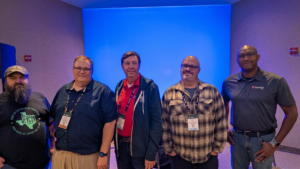
The session wrapped with a panel featuring Chris Bray, Craig Pember, Jeff Benn, and myself, fielding questions directly from the audience. This kind of open, unscripted Q&A is precisely what a lot of us have been asking for since DevCon disappeared from the schedule, and it delivered. After the session and during the conference, I had many people compliment me on my remarks at DevCon. Some asked if a session like that can happen more often.
Where this goes from here.
DevCon’s return this year was a strong beginning, not a finished product. There’s room to expand the track, add more depth in future years, and give the technical community even more reasons to make the trip. I’m hopeful, genuinely hopeful, that Blackboard keeps building on this rather than treating it as a one-year experiment. The admin and developer community showed up. Now it’s on Blackboard to keep giving us a reason to. The biggest issue that many folks shared was that DevCon and the Strategic Leadership Summit happen at the same time. Many people want to attend both, and the competing programming is a disservice to those who wish to attend both events. If you noticed, I wasn’t able to cover or share any insights from the Strategic Leadership Summit for this reason. Hopefully, conference planners can look at how to provide both tracks without competing.
Technically Yours,
The Blackboard Guru
