
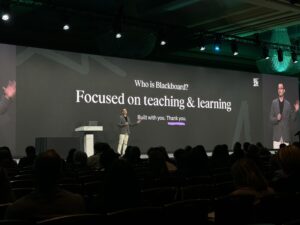

Author’s Note: This post is the second of a series. Each post will focus on each day of Building Blackboard Together 2026 and include a final evaluation of the conference based on these posts and thoughts found in June’s blog post.
Before we jump into the conference, just a moment to pause about the title of this and the upcoming blog posts. Blackboard was founded back in 1997. The software is nearing the start of three decades helping educate students around the world. Millions of people have learned thousands of topics through this application. Students who start college and use Blackboard this fall may have had their parents using Blackboard when they were taking college classes. Blackboard is the first generational LMS that’s teaching to the children (and possibly grandchildren) of its first users. A lot of the conversations in the coming posts will center around where we are in the development of EdTech software with AI, credentialization of degrees, and trying to help students understand the importance of learning how to learn. But this conference shows all attendees a single thing. The experience, the tools, the research, and the community have made today’s Blackboard the best learning management system on the market.
Building Blackboard Together: Day One Begins
Day one of Building Blackboard Together 2026 in Dallas covered a lot of ground. An opening from CEO Bruce Dahlgren, a keynote from a Stanford professor emeritus who spent an hour telling ed-tech to slow down, a product keynote that ran through nearly every corner of the company’s portfolio, and a Catalyst Awards ceremony to close the evening. Here’s the full recap.
The opening: Bruce Dahlgren sets the tone
Bruce opened by grounding the whole event in a common value for attendees, helping learners and instructors learn skills to become successful human beings. Then he got to the news everyone in the room already knew was coming: Matthew Pittinsky, one of Blackboard’s original founders, is returning as CEO, likely toward the end of the year. “I’m proud to tell you… that Matt Pittinsky is coming back. It is a Back to the Future. Here is an original founder coming back as the CEO… and I don’t know if you could write a better story candidly.” It’s difficult to argue with the framing. An original architect of the company coming back to lead its next chapter is a genuinely compelling story, whatever you think of the timing or the process that got us here.
He walked through the two-day agenda: David’s keynote and the product keynote on day one, followed by the Catalyst Awards that evening, then a fireside chat with Pittinsky and new board addition Lev Gonick on day two, capped off by the customer appreciation party. Bruce also took a moment to publicly thank Blackboard’s employees, the ones who worked to pull the event together and the ones who kept the lights on back at the office while they did it. “I think this is the most dedicated, committed, talented team of employees that [I] might have worked with, and I want to make sure that they hear that and thank that.” That’s worth acknowledging. It’s easy to forget the event itself doesn’t run on keynote slides alone.
In his closing, Bruce’s now-recurring “backstage with Bruce” tradition, rebranded this year as “on stage with Bruce,” where he had the room shout a group hello on camera for the employees who couldn’t be there. A little theatrical, sure, but the sentiment behind it can be summed up in Bruce’s closing comments, “This company is in a really good place… You’re going to be impressed with what you see.”
The opening keynote: David Labaree on a system that resists you
Blackboard brought in David Labaree, Stanford professor emeritus and one of the most influential historians of American education, to open the conference. If you were expecting a warm-up act for the product announcements, this was not that.
Labaree’s core argument: American education is a massive, resilient, loosely coupled institutional system that has survived for centuries. Its survival is precisely because it resists rapid change. “Educational technology, like any other mechanism for tinkering with the American system of education, needs to develop a rich understanding of how the system works before messing with it.” This idea resonated with me, and I’m sure many others in the audience. We have seen over the past two decades legislative and administrative changes to the frameworks of our educational systems that seem to change wherever the political winds blow. Never giving educators and administrators the chance to fully implement and evaluate the success or failure of these changes. It’s always been a frustration in my personal beliefs, and it was nice to hear someone of Dr. Labaree’s stature state it.
His lecture walked attendees through the history of how American higher ed grew from a scattered, underfunded 19th-century afterthought into the dominant educational system in the world. Largely because of the institutional autonomy that keeps it inefficient and, in his telling, effective for exactly that reason.
He laid out the three competing goals baked into the system since its founding: democratic equality, social efficiency, and social mobility, goals that are fundamentally in tension with each other and always will be. That tension, he argued, is why credentialing has increasingly displaced actual learning as the thing students are chasing. “The pursuit of education thus turns into the pursuit of credentials.” According to Labaree, once they did, Goodhart’s Law kicked in: they stopped being reliable measures of the thing they were supposed to measure.
Then he turned to AI directly, and this is the part that should stick with anyone building ed-tech. Labaree’s warning was blunt: AI tools that let students bypass the actual cognitive work of writing and reading aren’t solving education’s problems; they’re accelerating the worst tendency the system already has, gaming the credential instead of doing the learning. He makes a great analogy to fast food versus a slowly made meal.
“Official education… is fast food, but real education is slow food. You can’t fast-forward through the process… and claim that you’re educated.”
In closing, he challenged edtech leaders and Silicon Valley visionaries, “What students need is a different form of educational technology than the current AI model, one that supports them and challenges them… This is not a setting where it makes sense to follow the long-standing Silicon Valley model: move fast and break things.” However, the quote I find most memorable for attendees from Dr. Labaree is, “This is a system you are working with. You should be trying, not unlike many reformers before you, to at least do no harm.”
It was a dense, sometimes uncomfortable talk to sit through at a vendor conference, and I mean that as a compliment. It set up the entire day that followed. Below is a quick biography and links for Dr. Labaree’s blog and his available books.

David Labaree
Lee L. Jacks Professor, Emeritus — Stanford University Graduate School of Education
David F. Labaree is Professor Emeritus at the Stanford Graduate School of Education, where he held the Lee L. Jacks Chair. A historical sociologist of American schooling, his scholarship examines how high schools evolved, how consumerism reshaped education, the origins of schools of education, and the ways schooling has often served access and credentialing over subject-matter learning. He is the author of several influential books on the history and sociology of American education, and he writes regularly for a general audience on his own blog.
Selected books: The Making of an American High School (1988) · How to Succeed in School Without Really Learning (1997) · The Trouble with Ed Schools (2004) · Education, Markets, and the Public Good (2006) · A Perfect Mess: The Unlikely Ascendancy of American Higher Education (2017) · Being a Scholar: Reflections on Doctoral Study, Scholarly Writing, and Academic Life (2023) · The Ironies of Schooling (2024)
The product keynote: reach, teach, demonstrate
Dom Gore, Executive Vice President of Product for Blackboard, took the stage next with the product team and opened by tying the presentation directly back to what the room had just heard from Labaree. He framed the entire roadmap around three questions: how do we reach every learner, how do we teach well in a world of AI, and how do we demonstrate that it’s worth it? Those three questions mapped to three portfolio pillars: Learning, Accessibility, and Evidence. He also shared what sounds like a key mission statement for the company, “Technology should be centered around education, not the other way around.” A simple statement, yet we as administrators, developers, and instructors sometimes fail to keep in our minds.
Next he shared the scale of Blackboard today: over a million users across 76 countries, the Blackboard LMS running at 1,200 institutions and reaching 16.5 million learners, and AVA (the AI virtual assistant) logging well over 10 million interactions to date. On the accessibility side, Ally is in use at 1,000 institutions, has scanned over 114 million courses, and processed well over 450 million content items in the last year alone, with an average 60 percent improvement in accessibility scores where it’s deployed. On the evidence side, Blackboard’s institutional effectiveness and evaluation tools support more than 450 institutions, with 3.3 million learners providing feedback across 400,000 courses. For many in the sector who doubt Blackboard’s continued presence in the market, this should be a wake-up call.
Dom then invited Kelly Herman, VP of Accessibility and Student Affairs at the University of Phoenix, to the stage to discuss nearly ten years of working directly with Blackboard’s accessibility team. Her message to the room was simple: get involved in the Idea Exchange, show up to office hours, and treat the relationship as a genuine partnership rather than a vendor-client transaction. “That relationship between us and Blackboard has been a real important aspect of what it is that we do for our students.” This is what puts Blackboard head and shoulders above other companies in the LMS marketplace. It’s the kind of testimonial that only lands if the partnership is real, and from what she described, it sounded like it is.
Security first, then support
Before getting into new features, Dom pivoted to security, and to his credit, didn’t try to make it flashy. Higher ed is now attacked at roughly twice the global average rate, and the point was made plainly: nothing else in the roadmap matters if the foundation underneath it isn’t trustworthy. Blackboard’s engineering is aligned to national and international standards, with penetration testing and privacy reviews built into the release process rather than bolted on after. The company’s security governance is owned by an executive compliance committee and certifications, including ISO 27001, FedRAMP, and DoD Impact Level 4. Something that few institutions really consider when purchasing an LMS> “Only about 1 in 5 institutions has a real policy for [their] vendors in relation to their services.” Given everything the industry has watched play out with Instructure’s Canvas breach this year (see my blog posts, The Breach Instructure Saw Coming (And What It Means for the Rest of Us and The Canvas Breach, Blackboard’s Security Posture, and the Five Things Blackboard Admins Can’t Outsource for analysis on the event) this section carried more weight than it would have a year ago, and I’ll have more to say about that comparison in an upcoming post.
From there, Jennifer Ziegenmier, Blackboard’s new VP of Global Support and Services, walked through the support model overhaul that’s been the subject of a lot of chatter by me and others in the community over the past year. The headline change is for those who put in tickets; there will be a single-owner from start to finish. No more bouncing between tiers; these single owners will be backed by direct access to product and engineering experts. Support is also getting an AI-powered intake layer, a new customer-facing support portal, and an internal Agent Health Center. Other enhancements include expanded language coverage to over 40 languages and a new metric Blackboard is tracking called customer effort, alongside the standard SLA and CSAT numbers. Ziegenmier was candid that changes are still in motion and asked for patience as the redesign rolls out over the coming months. I’ll be watching to see whether that patience is rewarded.
Ally auto-tagging and the new content editor
Dr. Amy Lomellini’s team demoed Ally’s new PDF auto-tagging feature using the now-familiar “Elizabeth and Darius” persona pairing Blackboard has built its roadmap narrative around in previous years. Elizabeth, an instructor juggling multiple institutions, uploaded an inaccessible PDF, and Ally walked through generating the tag structure, letting her approve the changes, and then handling missing image alt text with an AI-assisted description tool she can edit before it’s written back into the file. What used to be hours of manual PDF remediation is now a guided, in-workflow process measured in minutes, with the instructor approving every change rather than losing control of the document. Amy’s statement from the stage is the real reason why so many of us find Ally so valuable: “Students with disabilities like me should never have to wait for usable course materials.” Exactly.
A new content editor is also rolling out, described as a full rebuild rather than a coat of paint, with cleaner formatting tools, better table and list handling, and accessibility built in from the start rather than added afterward. Early access for the editor opens in August for Blackboard documents, expanding through the fall, with full rollout in December.
AVA, flashcards, and Cursive
Richard Gibbons demoed two new AI-generated study tools inside Elizabeth’s course: AI-generated flashcards grounded in actual course content (a part of the core Blackboard product), and a new “pulse quiz” conversation type that generates quick, personalized quizzes on the fly (a part of the AVA license). “This is genuinely giving [students] an opportunity to identify the strengths and gaps in [their] own learning,” according to Gibbons. Both are built around the same principle Dom stated up front: AI drafts, and the instructor decides. Richard then shared the current acceptance rate on AI-generated suggestions has held steady around 50 percent for two to three years, which Blackboard is framing as evidence that instructors are actually reviewing rather than rubber-stamping those suggestions.
Then came the introduction of Cursive, a new authorship-verification tool. This purchase of Cursive Technology, which started in 2022 on the University of Maryland—College Park campus, was founded by Joe Thibault, who continues to be at the helm of the product. The tool doesn’t scan a finished document for AI-generated patterns the way a classifier does, or compare it against a database of existing text the way traditional similarity checking does. Instead, it verifies the writing process itself using keystroke behavior, revision history, and time on task, as the student writes. It runs in-browser or through a desktop app, works with Google Docs, Word Online, and Substack, and is explicitly positioned to work alongside Turnitin rather than replace it. “Cursive is already used at more than a hundred institutions… built to work with any LMS, any institution, not just Blackboard.” You can read more directly from Blackboard at blackboard.com/cursive, or from the company itself at cursivetechnology.com.
Scholar: the academic planner
Ron Robertson, a new Blackboard colleague who previously co-founded Picmonic, introduced Scholar, described as an AI-native academic planning tool built for the learner directly rather than the instructor or administrator. Blackboard is starting deliberately small this fall with a select cohort of institutions, with the stated goal of understanding how student studying habits are actually changing and what tools students reach for when given the choice. More on Scholar at hub.scholar.com and scholar.com.
After the unwinding of the Blackboard/Anthology merger, these announcements mark the first real steps to diversify the company since that time. An interesting item is how much the purchase of Cursive cost Blackboard after talking about being debt-free post Anthology. While I will agree that these two products, Cursive and Scholar, are smart tools and fit well into Blackboard’s leaner portfolio. Clients and customers have to wonder how much development on these tools takes away from the development of the core LMS product.
A rebuilt Gradebook and a shift on assessment
Dr. Misty Cobb walked through the redesigned Gradebook grid, with more rows and columns visible at once, a new assessment details panel that lets instructors navigate and grade without touching a mouse, and a much-requested single-click “post all grades” action. It’s not a flashy feature, but like Misty said during the demo, “This is what helps you when it’s 11 p.m… you have 30 students to grade and you’re halfway through.” It’s the kind of change that actually matters day to day.
The bigger shift came in how Blackboard is approaching assessment itself. Rather than trying to detect whether AI wrote a given submission, which Richard Gibbons demoed through Darius’s side of the workflow, the emphasis is moving toward giving students real-time, rubric-based feedback on their own work before submission. While also giving instructors visibility into the revision process rather than just the final product. Dom shared that this is how instructors can tackle policing AI to verify authorship, and it’s backed by real institutional work: over 220 institutions have participated in a working group on redesigning assessment for the AI era, with three white papers already published.
Sessions
There were many sessions after the opening conference and product keynotes. One was my presentation on Implementing Institutional Hierarchies, which I got many compliments on. That presentation is available on my presentation site, presentations.blackboard.guru/implement-IH. I also took a walk around the vendor area during my lunch break. While the space was cozy, it made the area feel very engaging and easy to navigate in comparison to the mammoth spaces that so many conferences have these days.
The Catalyst Awards
The evening closed with the Catalyst Awards, Blackboard’s annual recognition program, this year honoring 30 institutions across eight countries, selected from 136 submissions across 19 countries. Winners spanned eight categories. Congratulations to every institution and team recognized, including the University of Phoenix’s Academic AI Pillar Implementation Team, honored for Ethical AI Leadership, which felt fitting given Kelly Herman’s appearance on stage earlier in the day. The full list of winners is available at blackboard.com/catalystawards.
Closing Remarks
The day, and this post, was heavy with insights and information. Something that many who attend in person will gain, but can be difficult to summarize to non-attendees. This year I have relied on more personal audio recordings of the keynotes to help me provide a better, more in-depth analysis of the conference. This hopefully provides non-attendees with a better insight into the conversations and details discussed during the event while providing attendees with the ability to reflect on the conference from a different perspective.
There was a real thread running through the day, from Labaree’s warning about technology bending to fit the system rather than the other way around, straight through to Dom’s own framing of the roadmap. But the big question on many minds was the future of Blackboard and its incoming leader. While Pittinsky continues to complete contractual obligations, his ideas on where the LMS industry at large needs to go await attendees. Those words, from the future company CEO, offer a crystal ball into the future and hold the most important information for those in attendance.
Technically Yours,
The Blackboard Guru
